Sunday, March 04, 2007

Tuesday, March 6, 2007
Lent Reading Day 12
Anointing of Saul
1 Samuel 9:15-10:1

The Israelites clamor to be like everyone else, giving into to the peer pressure of fitting-in as an emerging nation in the ancient world, they beg God for a king to rule over them. They trade the direct relationship with God (through the priest Samuel) for one in which God rules them but through the power and presence of a human king.

As I read this story I wonder how Saul felt? I mean he doesn't seem to know that he is going to become king, and that Samuel has been instructed by God to annoint him to this newly created position in the Israelite community. How does it feel to hear "God wants you to be king." I wonder how it felt for Samuel to say it?

I'm struck by Saul's comment, "I'm only a Benjamite..." It seems to me that such a phrase shows up in nearly every major story of a transformational experience of God's presence and purpose in the Hebrew Scriptures. Abraham. Sarah. Moses. Hannah. Samuel. "But I'm only...." It's amazing how God transforms the humble "I'm only..." into something more.


"Samuel annointing Saul"
Monday, March 5, 2007
Lent Reading Day 11
The Call of Samuel
1 Samuel 3:1-4:1

The story of Samuel hearing God's voice in the night strikes me as a tragic-comedy - along the lines of an episode of Three's Company integrated with ER. Eli - the chief priest - the one that is supposed to know God and to recognize God's voice is not the one that God speaks to. Instead the voice of God comes to the child Samuel, whose mother Hannah entrusted him to Eli to live in the temple in the service of the Lord. Samuel mistakes God's voice for Eli's who then is irritated that the boy keeps waking him up in the middle of the night. But then Eli realizes what is happening and teaches Samuel to recognize the call of God and to repsond to God's presence and purpose. The story challenges us about the voice of God...do we recognize when God comes calling? Or are we too busy?; too distracted?; too doubtful?; or maybe waiting for God to speak to us on our own terms - like in a podcast or a cell call.

God calls and his call of Samuel means that God is not calling the deliciously and seflishly gluttonous sons of Eli. The authority of being the priest of God passes from Eli to Samuel. God's call doesn't have to do with birthright, genetics, social standing, or even already being in a place of political power. Rather God calls the unexpected. God speaks to those that are listening for God's voice, not saying what they think God wants for others only to get ahead themselves. Samuel as we'll see in the subsequent readings for Lent becomes a great and wise priest of the Lord, leading the people, listening to God's Voice, obedient and in the service of God's will. In our own lives - and in our denomination - we often think that God most speaks to those with a Masters degree of Divinity, with a particular background, extensive knowledge of the Bible, or who are repeatedly in positions of power. Yet the story of Samuel reminds us that God calls according to God's vision - not our resumes, pedigrees, or power-hunger. The God we've seen so far in the readings of the Bible is one that is revolutionary, overthrowing the power structures by speaking to the people of the margins - the prophets, children, the barren, sick, excluded, overlooked and forgotten. In our own lives, and in our own church, who do we look to to speak for God? In doing so are we looking to those people or looking to God to speak?

by Julius Schnorr von Carolsfeld, 1851-60. World Mission Collection

Saturday, March 03, 2007

go outside and testify
An editorial from Monte McClain
The past weeks have seen a surge in political activity. From the positioning of multiple candidates on both sides of the spectrum, you would think that the presidential election is slated for next month. Several are already the darlings of particular groups – whether that be Hollywood, the Political Parties, the Red States, the Blue States, or the Evangelical Lobby. Each claims to speak for the whole, for the diverse people of our nation. In the same time period, Molly Ivins, the prolific nationally syndicated columnist, died of breast cancer. In her final column she encouraged her readers – and all citizens – to remember that “We are the people who run this country. We are the deciders. And every single day, every single one of us needs to step out and take some action…” Granted, Molly Ivins spoke and wrote from one side of the political spectrum, but in meditating on those final words of a long career, as she faced her imminent death, I’m struck by the power of her thought in terms of being a disciple of Jesus the Christ and living my faith out in the context of our Fruitvale Presbyterian Church faith community.

It seems that faith is being spoken of wherever you look. The possibility that Jesus’ tomb was discovered along with Mary Magdalene’s and their baby’s in Jerusalem is the subject of a current Discovery Channel Show. Several outspoken conservative Christian leaders lambaste the front-running Republican nominees for not being Christian enough. The power of a good life – the ideal life – is being heralded as the secret knowledge contained in the latest best-seller called The Secret; if we simply envision and focus upon the things that we want, we will supernaturally attract them to us – good jobs, cash, the perfect car, and a leaner body will simply appear as we think about them. All of these events are occurring and being discussed as we journey through Lent – the church season in which we take the time to focus, or maybe re-focus, on who Jesus of Nazareth was, what he said, and how he lived in a way that revealed that he wasn’t just a good teacher, possessed a secret for material wealth, or was the foundation of DaVinci code related mysteries; but rather that he was and is the Living Christ who transformed the universe through his death and resurrection, and invites us to transformation by living in that same resurrection power today, here, and now.

How often is it that we let others – politicians, Hollywood stars, day-time TV divas, or best-selling authors – speak for us? In a generation in which many people have no personal experience with the church community or the faith we profess and possess in Jesus Christ, how can we be surprised when we seem to often let others speak for us because they have a title, following, or celebrity? We tend to believe – and rightly so – that God will provide the testimony, spread the good news that the resurrection of Jesus Christ brings power, purpose, and passion to our daily lives, meaning to our work, and transformational community to our congregations. We tend to think that God will provide someone else to do that testifying. We don’t want to be a bother in the line at Safeway, a nuisance in our workplace, or a lightening rod in our neighborhood. I’m reminded of the story of Esther in the Hebrew Scriptures, in which Esther becomes the queen. She wonders how God will save her people, and her uncle Mordecai plainly states to her, “who knows but that you have come to the [position in which you are] for such a time as this?” (Esther 4:14)

If there is a secret to faith it’s that God also has faith in us, that through Jesus we too can spread the good news of God’s love and justice through our words, actions, presence, relationships, and silence. God doesn’t simply entrust this mission to the professional clergy, the PhD’ed, or Nobel Prize-winning writers. We are the people that make up the church. We are those invited to share the story of resurrection and our stories of spiritual transformation. And every single day, every single one of us needs to step out and take some action to testify to what we believe and how it changes the world. We need people in the streets standing for justice, voicing the concerns of God’s heart, and working to make the Peace of God the Peace of our World.
Peace to you and yours,
Monte

Friday, March 02, 2007

March 3, 2007
Lent Reading Day 10
Joshua and the Battle of Jericho:


The Israelites have made it out of their 40 years of wandering in the wilderness, leadership has passed to the next generation from Moses to Joshua. They enter the promised land and take Jericho the first main town they encounter. Bloody and destructive - it can seem like a bizarre story of the people of God finding the home that God promised them in their pillaging the home of another. What's the point then of this story? Is it reinforcing the idea that the Hebrew Scritpures are merely written to advance and justify the perspective and worldview of a particular people? Or is there more?


What strikes me in the story is that Joshua and the Israelites trust that God will provide. In seemingly unbelievable ways that first meet Rahab, remain faithful to her hospitality...and God provides for the Israelites in a miraculous and mysterious way. How often do we truly believe that God will provide? In our day and age it's much more common for us to feel entitled to something, believing that we deserve it and must take it by our own means. Yet the sotry of Jericho reminds us and invtes us to trust that God will provide.

March 2, 2007

Lent Reading Day 9

The Ten Commandments:

Exodus 20:1-17, Deuteronomy 5:1-21

Simple yet profound, the ten words given from God to Moses for the Israelites serve as a foundation for their community life together. Not just a set of rules, of do's and don'ts, they serve as guiding ethic by which the Israelites life-in-community is shaped. They value life, respect the other, and integrate that in the belief in the God that freed the Israelites from oppression in Egypt. They tie together in a deeply interdependent way relationships between God and people, between people and each other, and the way that we consider ourselves. They serve as a reminder of God's priorities, the purpose of creation, and the way that we ourselves want to live in freedom, solidarity, and community.

As you read them what strikes you, grabbing your attention? Why is that? Read the texts again. What is the difference between the Exodus version and the Deuteronomy version? Hint: look at the commandment about the Sabbath. What does it mean to be free? What does it mean to rest in a sabbath-way? How are you missing those values in your life? How are we neglecting them in our society? The commandments are given to remind the Israelites of who they are and who God is calling them to be in their new-found freedom. How do we forget who God calls us to be and how we called to live as a people?

Sculpture "The Tablets of the Law" from the Ratner Museum

Wednesday, February 28, 2007

March 1, 2007
Lent Reading Day 8
Moses and the Burning Bush:
Exodus 3:1-22

Moses has fled his past, fled his future, and chosen a present that enables his to hide from his fears, failures, and family situation in Egypt. Alone in the wilderness, tending the flock of animals he cares for, he stumbles suddenly upon a bush that burns yet is never burnt up. Seeminlgy indestructible, Moses is intrigued and as he approaches comes into a face-to-face encounter with the living God of the past, the present and the future, who was, and is, and is to come. Moses experiences an epiphany, an experience of God revealing himself in the midst of our world. He takes off his sandals as a sign of respect for this holy ground, but it's more than his footwea that changes. Trasnformed by his encounter of the God of his ancestors - who now is clearly the God of Moses too, he cannot simply go back to business as usual. The voice and word of God has gone out, the call has been extended and Moses accepts - even if he still bickers and complains abit in the rest of chapter 2 because he stutters.


How often do we walk past holy ground epiphanies in our own lives? Maybe we don't see burning bushes, or hearing booming voices from on high. But I have to believe that we're not all that different than Moses. Often when God comes calling, inviting us to stand up, lead, and stand for justice - freedom - community solidarity - we too are often afraid. But what was Moses afraid of? Was he afraid of failure? Or was he afraid of himself, afraid to have his stuttering fear transformed into clear leadership, prophetic word? It reminds me of an often quoted poem by Marianne Williamson


"Our deepest fear is not that we are inadequate.
Our deepest fear is that we are powerful beyond measure.
It is our light, not our darkness, that most frightens us.
We ask ourselves, who am I to be brilliant, gorgeous, talented, and fabulous?
Actually, who are you not to be?
You are a child of God. Your playing small doesn't serve the world.
There's nothing enlightened about shrinking so that other people won't feel insecure around you. We are all meant to shine, as children do.
We are born to make manifest the glory of God that is within us.
It's not just in some of us, it's in everyone.
And as we let our own light shine, we unconsciously give other people permission to do the same. As we are liberated from our own fear, our presence automatically liberates others."


What was Moses afraid of? What are we afraid of when we have our own burning bush epiphany encounters and are invited to be vital participants in what God is doing in the world?
Sculpture "The Burning Bush" from the Ratner Museum

Tuesday, February 27, 2007

February 28, 2007
Lent Reading Day 7
Moses in the Bulrushes:

A children's Bible we read at home describes this story as "the baby in the basket." The imperialistic Pharaoh has set out upon a program of ethnic cleansing, using all his power to wipe out the numerous Israelites. And yet his own daughter is the person to pull out from the jaws of death the child that will grow to lead the Israelites to a freedom at the expense not only of Pharaoh's pride but also his power.

It's a cute story. That's why my daughters enjoy it. That's why the Prince of Egypt was such a success in the movie theaters. Yet it's deeper than just cute, trite, or sweet. Pharaoh's daughter makes a choice - she seems to me to clearly know what she's doing and who is the biological mother of the child. She makes a choice to protest against her father's policy, to speak her mind, what she believes to be true - not only with her words, but also with her actions. She not only saves the baby in the basket that day, but his mother and sister as well. Her compassion and mercy are actually acts of justice and revolution. A recent newspaper column, the last written before her death from cancer, of Molly Ivins invited readers to politcial action, to acts of justice in simple, coherent, seemingly cute yet revolutionary ways.

How is God inviting us today to stand up and go outside like Pharaoh's daughter and take some action?

Art by He Qi, "Finding of Moses"

February 27, 2007
Lent Reading Day 6
Jacob’s Ladder:

Jacob, the son of Isaac, experiences the power, purpose and passion of God in a new, unavoidable way in today's passage. Read Genesis chapters 25, 26, & 27 to get the background of today's scripture story. Jacob's history is literally catching up with him. Like his grandparents he trusts more in himself to provide, than in God. So he has repeatedly taken things into his own hands, ensuring his safety, status and survival by trickery, deceipt, and self-reliance. But here as his vegeneful brother is closing in on him, and after giving up his family to his angry brother, he is overwhelmed by this vision of God through this ladder. It's from this point on that he changes - his life, perspective, and world-view is transformed. Better late than never we'd say. You might also say that it's easy to do that when you've already sacrificed your wife and children to save your own skin....but Jacob does literally see the light and change.

With all his blindness Jacob is able to discover, discern and understand that he is in a holy place, that God is present - not just in that square yard of land, but in all of life. How are you aware of God's presence? How would you like to be aware? It's in Jacob's dreams that God comes to him - the one time in his day in which he lets go of his total control over the way he reacts to all of life. It's in his dreams that God is able to come to him and be heard. How are you open to God coming to you, speaking to you God's power, purpose and passion?
February 26, 2007
Lent Reading Day 5
Abraham and Isaac:

The story of the barren Abraham and Sarah journeying through the desert towards a new promised land and the promise of a child climaxes with the birth of Isaac by God's grace. Of course between this gift there were many times in which Abraham and Sarah scheme and sneak their own ways, trying to make what God promised happen by their own grit, greed, and guts. Isaac is born - the child of laughter - what his name refers to, reminding the proud parents each time that they call their son by name that they laughed when God made the promise of a child, doubting, disbelieving and discrediting that God could do such a mysterousily miraculous thing.

God then paradoxically invites and commands Abraham to take Isaac into the wilderness, and there to offer his only son, the long-awaited promise of future life, the fulfillment of his present moment, and the deep trust in God's goodness, in sacrifice. Some would say this is a demented and destructive God, asking parents to sacrifice their own child for God's glory. Yet it's a test - a cruel one in a way - to see what Abraham trusts in. Does Abraham trust only in his own power to provide for himself and his family (which is what he seems to do in most of his life)? To what extent does Abraham trust that God will provide?

We live in a time of great narcissim. One of the fastest selling books at the moment, the Secret, asserts that we can attract the future - the money - the looks - the body size - the material goods - that we want. Heralded by Oprah and Ellen, the divas of day-time tv, this new book, describing old thoughts, proclaims that we make the positive and the negative things happen in our life. It sounds catchy and encouraging...imagine yourself in that Porsche that has been prius-ed to get 150 mpg, and you'll soon be in it. Yet what about the downsides, that we make negative things happen by our thoughts? Is this really true when we think of what it means for those that lost everything in New Orleans, who live trapped in the Sunni Triangle in Iraq, or seeking to thrive in the midst of HIV-infected countries in southern Africa? Do we really have that much power over the universe?

Instead I'm struck by the memory of this story - which is foundational in Christianity, Judaism and Isalm - reminding me that God will provide and does provide. In fact the place where this story supposedly happened has become both the temple mount in Jerusalem and the site of the Mulsim Al-Aqsa Mosque. As I dwell on the invitation to trust that God will provide in the midst of our radically narcistic culture (check out the Oakland Tribune article that describes a study detailing the increasing rate of narcissim among college students and the possible negative effects on our culture) I'm pushed to look for different examples of trust, gratitude, and other-centerdness in our culture. I think of the acceptance speech of Supporting Actress Jennifer Hudson at the Academy Awards this past Sunday, when she said repeatedly, "I thank God." "God is so good."

In whom do we put our trust? How do I believe that God will provide for me, my family, and our church community? How do I second-guess God, by ensuring by my own powers and schemes - in an AbrahamSarah-ish way - that I'm provided for when God doesn't seem to be acting, or doing things the way that I'd like them to be done?

Friday, February 23, 2007

February 24, 2007

Lent Reading Day 4

The Call of Abram: Genesis 12:1-9


What does it mean to be called out from your people, tribe, nation, and culture to go to a new place, to make a new home, that God will show you? I find it hard to imagine. How would I respond it such a circumstance? How would you? And yet - is it really so unlike what we all live?; what we all are invited to? I was watching Grey's Anatomy tonight whch begin with the statement that Doctors believe in Science, not things such as miracles. The next philisophical musing was a post-modern response saying that science is wrong, that miracles do happen. The miracle in the Abraham and Sarah story isn't so much that they were old, worn, and baren and yet birthed a nation, but rather that they said, "yes" to God's invitation to relationship - one that led to new discoveries, unexpected journeys, and out-of-the-box ways of knowing and being known. The truest miracle of the journey of Abraham and Sarah is that they lived their life of blessing being a blessing to others... Blessed doesn't mean happy-go-lucky, or that everything is easy or turning-up-roses, but that life is full, whole, and meaning-full. I'm much quicker to want to take the blessings that come my way, than to pay them forward, to be a blessing to others. What does it mean to bless others in our actions, words, relationship, presence, and prayers? Maybe - just maybe - when we're so quick to want God to do miracles for us - to make life easier, to grant our wishes, to wipe away our challenges, we're overlooking the mystery that maybe God is inviting us to be miracle-doers - blessing others when both we're happy and healthy, and when we're broken and lost.
February 23, 2007

Lent Reading Day 3


The story of Noah, the Ark, and the great flood is well known, in particular when you visit stores that sell decorations for baby rooms. It always strikes me that we often decorate children's room and dress them up with figures from this story that at first-glance seems so destuctive, and divisive. Is the story about a God who destroys everything that God created because things don't go as God planned or imagined?; or is it about a God that takes the initiative, inviting to a deeper relationship?


The story of the great flood existed in the myths of many of the ancient cultures in mesopotamia. Many scholars assert that the Israelites adopted this story from their neighbors, transforming it, claiming it for their own faith community. The selection for the day leaves out the part of the stoy that reveals God's heart, passion, and purpose. Genesis 8:15-22 talks about the unique aspect that the God of the Bible promises to never bring about such cataclysmic destuction again, making a covenant with Noah and his family to be in relationship with them.


What does it mean for us that God makes a covenant to be with us, to be for us, and to be among us? How does such a promise change how I live my day, the decisions I make, and the way I invest in my relationships?

Wednesday, February 21, 2007

February 22

Lent Reading Day 2

Creation of Man and Woman


I've heard, as probably many of us have, multiple negative comments about this text. God is mysoginist - seeming to hate women, and the story protrays the woman as the only "bad" person - the tempter. Others have said that God is unfair, setting Adam and Eve up for a fall, tricking them into being disobedient. Others have said it's just ridiculous to think - in our post-modern, post-industrial, scientific-worldview-based-world, that such a ridiculous story could explain the creation of the world that took hundreds of thousands, in not millions, of years to evolve, emerge, and exist. Plus no one has ever found this "garden of Eden" - so it must be an ancient myth told and re-told be pre-enlightenment peoples to make themselves feel better.

These comments all miss the point of the story - at least how the story of creation strikes me. Yesteday's reading (Genesis 1:1-2:4) also tells the story of creation. So the Bible actually has two versions - side by side - of the story of the beginning of the universe. If the writers of the Bible were trying to offer a conclusive, evolutionary and scientific explanation of the genesis of the cosmos I doubt that they would have included 2 stories - unless their editor was on vacation the week they put Genesis together. The first chapter tells the story of creation as an invitation to a conversation with God - a God who speaks things into being, speaking with creation as co-subjects, equal, and with whom God seems to be interdependent. The second chapter - today's text - tells the same story with a different theological point - that we are created in God's image - but are not God. The man and woman are equal in creation. For God doesn't create Eve from Adam's foot - but from his rib, his side - the part of the body that will be side by side with her when they are standing together side by side. I think this shows God's intention for interdependence, mutuality, and equality in creation from the get-go. (Of course this isn't my idea - it comes from several French medieval theologians). The fruit in the garden - the temptation of the snake - and the evenutal banishment of Adam and Eve are not meant to paint an unloving portrait of the God of the univese as without mercy, grace, and patience, or meant to justify the latest jockey or 2xist underwear marketing schemes. Rather they remind us of the human condition - that we all are part of what a friend calls the "circle of life." We all are born. We all will die. Adam and Eve seek to change that, with some suggestive encouragement from the snake. Curiously the world "devil" comes from the Greek work "diabolos" which means "the one who divides." And isn't that what happens in this story? In the beginning Adam and Eve are living in interdependence with God and with each other...but by the end they have turned on each other (who else do they have to blame in the garden?) and on God.

How often do I - and we - turn on each other when we're afraid or confronted with our own mortality, brokeness, fears, or uncertainties. As mythical, distant, or destructive (read Sam Harris' latest book) we might suspect these ancient stories to be - there is a reason that these two chapters; two versions of the same story, are at the beginning of what became the collection of testimonies about God that we now call the Bible. They remind us that the God of the universe is seeking us out, taking the initative, inviting us into a conversation - a dance of co-creation and interdependence, and that we in our human-ness somehow learn radical mistrust from one another - what the Biblical writers call sin - fearing that there won't be enough for us, to go around for me to get some, or that God will or even has forgotten us. In this second day of Lent - we have to ask ourselves - how does mistust of God, of others, and even ourselves - rule our lives, reign over our decisions and actions, and govern the way our cultures and nations deal with one another?
Ash Wednesday
February 21, 2007
Lent Reading Day 1


The first reading in the Read Through the Bible Lenten Spiritual Discipline Blog Entry starts in the beginning - the first words of the Bible in the book of Genesis are actually, "In the beginning...", not "in the first instant," not "in that moment before the big bang," not "before the process of evolution emerged," simply "in the beginning." We often read the text putting our values, expectations, and worldviews upon the text, making it speak our language, talk to us on our terms, or even tell us what we want to hear. In light of our scientific world-view and knowledge, we struggle with accepting that the world was created in 6 days or that God's word could create something out of nothing. But what I hear the text saying is that God speaks, taking the initative, addressing the first word in a dialogue. God's speaking organizes, transforms or shapes what already was - the darkness and the void - into something that is alive, dynamic and good. God speaks and the universe responds, joining into the conversation. God speaks and man and woman are created in God's image - creatures empowered with the gift of gab - able to participate in a discussion. God doesn't talk down to them, but rather with them. God doesn't begin creation with a dictation, or a speech, but rather with a conversation. A dialogue requires two actors or speekers, who are able to listen and speak, to interact in mutuality, interdependence, and relationship. If this is the first story of the Bible - then what I hear it saying is that from the beginning God has sought to be in relationship with us, speaking to us, taking the initative, so that we might respond, join the conversation, and become co-creators with God. I find that quite different than simply imagining that the creation story justifies this or that political party platform, a pro- or anti- position vis-a-vis science, or even a line-drawn-in-the-sand approach to faith in the Judeo-Christian perspective. How radical to imagine that God is still speaking (as the Methodists say in their marketing) - and speaking to us - to me - inviting me to join the conversation. If that's the case how often do I approach life: my decisions, actions, relationships, and words in the view that I'm part of a conversation and not simply the center of my own private world, or in a dog-eat-dog world, or a complacent cog in the midst of a meaningless machine? If God is still speaking - what am I saying?

Monday, February 19, 2007


is the period of 40 days before Easter (not including Sundays) that begins on Ash Wednesday. Since the first days of the Christian Church Community, nearly 2,000 years ago, Lent has been as season of spiritual growth, discipline, and maturation. Early converts to Christianity underwent a time of catechism, or faith instruction – including fasting – during these 40 days. This became a practice of “giving something up” during this time in order to be more mindful of the sacrifice that Christ made on the cross and in the crucifixion so that sin and evil might be overcome by resurrection grace and transformational faith-relationships with God. Instead of “giving something up” to be mindful of Christ and the new way of being in our world and relating to God and one another, thechurch community I serve (Fruitvale Presbyterian in Oakland, CA) wants to invite you to “take something on” during Lent.


Throughout Lent you can discover a new spiritual discipline that you can practice on your own in order to grow your faith and nurture your spirituality. These will be presented each Sunday by a special insert in the worship bulletin (which you can download on the church website). I'll also upload these inserts - including links to online resources - each Sunday until Easter (April 8th)

Throughout Lent, beginning on Ash Wednesday, February 21st, I'll be blogging on a daily basis, briefly sharing my thoughts about the sciptures that comprise a snap-shot overview of the entire Bible. If you'd like to try this as spiritual practice during Lent this year, simply tune into my blog each day. You'll find a link to the scriptures as well as a short reflection piece.

Here's the List of Scriptures that you can read through and which I'll be blogging about.

A Lenten Spiritual Discipline: Read the Bible on a Daily Basis
Readings for Lent “Through the Bible”

Day 1 Creation: Genesis 1:1-2:4
Day 2 Creation of Man and Woman: Genesis 2:4-2:25
Day 3 The Flood: Genesis 6:5-8:15
Day 4 The Call of Abram: Genesis 12:1-9
Day 5 Abraham and Isaac: Genesis 22:9-14
Day 6 Jacob’s Ladder: Genesis 28:10-17
Day 7 Moses in the Bulrushes: Exodus 2:1-10
Day 8 Moses and the Burning Bush: Exodus 3:1-22
Day 9 The Ten Commandments: Exodus 20:1-17, Deuteronomy 5:1-21

Day 10 Joshua and the Battle of Jericho: Joshua 6:1-20
Day 11 Call of Samuel: 1 Samuel 3:1-4:1
Day 12 Anointing of David: 1 Samuel 9:15-10:1
Day 13 David and Goliath: 1 Samuel 17:1-54
Day 14 The Shepherd Psalm: Psalm 23
Day 15 The Voice of the Lord Psalm: Psalm 29
Day 16 Advice from the Proverbs: Proverbs 10:7, 10:12
Day 17 Advice from the Proverbs: Proverbs 10:15, 10:20
Day 18 Test of Solomon’s Wisdom: 1 Kings 3:3-28
Day 19 Isaiah: Isaiah 9:1-7

Day 20 The Fiery Furnace: Daniel 3:1-30
Day 21 The Birth of Jesus: Matthew 1:18-25
Day 22 Baptism of Jesus: Matthew 3:13-17
Day 23 Plucking Grain of the Sabbath: Luke 6:1-5
Day 24 The Golden Rule: Matthew 7:12
Day 25 The Great Commandment: Mathew 22:36-40
Day 26 Healing the Ten Lepers: Luke 17:11-19
Day 27 The Widow’s Mite: Mark 12:41-44
Day 28 Lazarus and the Rich Man: Luke 16:19-31
Day 29 The Lost Sheep: Luke 15:3-7

Day 30 Laborers in the Vineyard: Matthew 20:1-15
Day 31 Calming the Storm: Mark 4:36-41
Day 32 Entry into Jerusalem: Matthew 1:1-11
Day 33 The Last Supper: Matthew 26:17-29
Day 34 Garden of Gethsemane: Matthew 26:36-46
Day 35 Arrest of Jesus: Matthew 26:47-56
Day 36 The Crucifixion: Luke 23:44-49
Day 37 The Resurrection: Luke 24:1-11
Day 38 Pentecost: Acts 2:1-3
Day 39 Paul’s Conversion: Acts 9:1-9
Day 40 God Wipes All Tears: Rev. 7:9-14


Sunday, February 04, 2007


PEACE – WHAT DOES IT COST?
An editorial from Monte McClain – Pastor, Fruitvale Presbyterian Church

“Peace I leave with you; my peace I give to you. I do not give to you as the world gives. Do not let your hearts be troubled, and do not let them be afraid.” – Jesus of Nazareth (John 14:25)

February is filled with celebrations that affirm our identity in community. You might watch the Super Bowl with your closest friends, celebrate Valentine’s Day with a significant other, celebrate Black History Month in our schools, faith communities or neighborhoods, or participate in Lunar New Year Festivities in different and diverse Asian backgrounds. Lent begins on Ash Wednesday the 21st, marking our 6 week journey towards the resurrection promise of Easter for us and our world. The month is filled with festive Feast Days in which we gather together in community to celebrate who we are culturally, historically, relationally, and also spiritually.


As Christians we gather together in our common belief that something universally unique and authoritative happened in Jesus the Christ. As disciples we share a common hope that in Christ the God of the Universe has given us a peace beyond all understanding, and that through Christ on the Cross this is made possible, and that by Christ we are invited and called to not only talk about such peace, but to work to make it the reality of our world. In the Christian perspective peace isn’t merely just the absence of War, rather it’s the fullness of God’s presence, purpose and passion in and for all of creation. It’s not a temporary surge, but a constant universe-transforming gift of grace, love, and wholeness. When we discover God’s peace we ourselves are transformed, finding the fullness of who we are created to be and become. It’s in the peace that God gives in Christ that we come home – not to become a couch-potatoes, but to discover and deepen our discipleship as ambassadors of Christ’s love for all the world. It’s not sanctioned by Congress, nor a mayoral policy, but rather God’s deepest desire for us and invitation to us to be co-participants in the continuing work of creation.


We are in need of such radical and life-transforming peace, aren’t we? The surging death rate of young men and women (as well as not so young) dying in conflicts around the world from the neighborhoods of Baghdad to the corners of Somalia remind us of our need for peace. The rate of violent crimes and thefts in our city of Oakland are surging towards new potential records in only the second month of the year. A recent article in the Tribune highlighted the gentrification in our own church neighborhood the Dimond District – and the “rebirth” of an historic city district. Yet at what cost will this gentrified fullness come? Who will be forced out by the surge of skyrocketing housing costs? If Christ gives us his peace – and does it differently than the world does – what does that mean? In a time in which many of us are fearful of what can happen and what is happening, what does Jesus’ invitation to “not be afraid,” mean for us?


February is filled with holidays and celebrations that invite us to peace – either in wishing us peace and prosperity for the new year, to share a peace-full moments with friends and family, or to remember and claim our diverse history in order to prevent the horrors or racism and xenophobia to tyrannize our society. As Christians, Lent invites us to fathom the cost at which God makes peace with us, and the universe through Christ. What does that mean for us? And how are we invited – or challenged – to pay forward our gratitude by being peace-makers in the name of Jesus the Christ in our world, our city, and in our church community – in words, actions, and relationships?


Peace to you and yours,

Monte

Thursday, January 18, 2007

HEROES

ORDINARY PEOPLE DOING EXTRAORDINARY THINGS

I WANT TO BE ON THE LIST

One of my most recently favorite shows to watch on TV is Heroes. In great part thanks to Uncle Tio, I've been irrevokably turned on to the under-the-radar creative genius of this show - which is part X-Men, part 1 Corinthians 12, part of my dream-world-come-true.

As I grew up I dreamed many times of being a super-hero, doing remarkable things, in particular as I so often felt so un-remarkably ordinary. Whether it was the under-water powers of Aquaman, the wonder-twin powers, seeing through walls, flying in the air, being able to control the weather, or even just to have the knowledge to build a teleporter and then go anywhere anytime...I always dreamed that such powers would be the ideal way to escape the boredom of life. The irony is that yesterday someone told me that "boredom is simply a lack of attention to detail." - I'm not sure what that means, or what they meant about me!?

Anyway this past week at Fruitvale Church we read and listened to the following scriptures Matthew 5:13-16, Romans 12:3-21 and 1 Corinthians 12:1-6. They talk about Jesus calling his disciples to be universe-transforming and life-sustaining SALT and LIGHT in the world, that such feats are possible by the many and multiply diverse gifts that the Spirit of God gives us in order for us (this is my favorite part - Romans 12:21) to not be overcome by evil, but to overcome evil with good. As I meditated on that word for the week, I couldn't help but think about Heroes - the similitude of those scriptures and the comparison/contrast between Peter and Hiro and Sylar. In fact I think maybe just maybe the writer-creators of Heroes are inspired by Christian faith or at least the Judeo-Christian perspective on community, vocation, and gifts....maybe it's James Dobson's true vision of family values?

In any case...is it really to freaky to imagine that God is actually calling us to be heroes and heroines...using our gifts to overcome evil for good - the good of all - as opposed to being sylar-ishly overcome by evil? Didn't Calvin compare predestination-salvation to being "on some sort of list?" Is it really all that far fetched?

Are you on the list?
If so who are you?
I took the test at quizfarm and discovered that I'm most like Peter and Hiro.


Take the test and see what hero you're most like here.


The story continues Monday, January 22nd @ 9pm on NBC.


Check out Hiro's Blog here.


Wednesday, January 10, 2007

PRACTICE MAKES AUTHENTIC
An editorial from Monte McClain – Pastor, Fruitvale Presbyterian Church

We often start the New Year with thoughts of regret and dreams of new opportunities and familiar pains that we hope to avoid. We see this in the endless list of “best-ofs” that come out at this time of year about the best music, movies, books, memories, photos, as well as the “worst-ofs” in music, actions of Hollywood Stars, decisions of politicians, government policies, and fashion statements. There is something deep inside of us longing for a better place, a deeper life, more meaning, less pain, some sort of transformation of our daily mundane lives into what the testimonies of the Bible call “New Life.” What’s ironic is that we seem to start each year looking back in order to know what to avoid in the coming year. The stories, ethos and worldview of the Bible invite us to look back differently. The stories of those that have gone before us in faith invite us to look back in order to remember so that when it happens again we’ll be ready – not to avoid it – but to seize upon the opportunities of grace, growth, and goodness that God will surely and faithfully provide again. The worldview of the Hebrew and Chrsitian Scriptures invites us to have Double Vision – not where we see double – but where we look back in faithfulness in order to look forward with vision and expectancy.

Proverbs 28:19 says “without a vision the people persish.” A friend often says, “without a road map you have no chance of getting where you hope to go.” January is a time of celebration and also of anticipation and reflection. Where are you going as a person of faith? Where are we headed as a community of faith? How has God been faithful to and through us in 2006? And how is God calling us to be faithful in our presence, purpose and passion in 2007? This month in worship we’re taking the time to talk about the four principal cornerstones of our church vision and core values (worship, administriation, visitation, and outreach – read more in this month’s Session report). We’ll be looking to the scriptures to hear about how our core values as a church community and the vision for our minsitries are not just based on my dreams, or on the limitations of our church budget, but upon what we believe to be God’s call for us.

In receving several new members into our church community this past month I was struck by their comments. Each was attracted to our church and kept coming back for more because of different and diverse things, from the concrete teaching to the relationships and community, from the emphasis upon social action to the creativity of our worship celebrations. Oftentimes church congregations are good at talking about change, transformation, and ministry, but slow to actually do it. My deepest hope for Fruitvale – and what we believe the Holy Spirit is doing – is that we continue to become even more of a community in which all peole can discover, re-discover, or deepen their faith; a community in which we practice being Chrisitian in our worship celebrations, community times, educational activities, and visitations – so that when we are all individually out in the world we will know how to and be able to be Christian – not necessarily perfect – but definitely in ways that are concrete, pertinent, and authentic. Jesus taught that we “are the light of the world….therefore let your light shine before others, so that they may see your good works and give glory to God in heaven.” (Matthew 5:15-16) As I sit here and type I realize how easy it is for me to say that and how challenging it is to do that. What does it mean to be a light? Are we not lights already? How do you keep shining as a light when you get tired, frustrated, overwhelemed or confused? Such questions and needs are why we gather as a church to practice our christian-ness in worship. It’s why we have the same liturgy each week – confessing our sins, being reminded of God’s love, praying for one another, listening to the Scriptures and giving an offering in response to God’s initial gift of life and love. We all know that practice doesn’t necessarily make perfect, but it does make us authentic…and isn’t that what we’re all looking and longing for in a faith community and church home?
Peace to you and yours,
Monte

Saturday, January 06, 2007

Children of Men


I recently escaped from reality for 2 hours by watching the current movie "Children of Men." Set in a future England, consumed by chaos following the unexplainable and sudden mass-infertility of the human race it discusses the themes of love, race, xenophobia, imperialism, freedom, and hope.

The film begins with the protagonist uttering, "I can't really remember that last time I had any hope, and really I can't really remember the last time anyone did." What would life be like in a world with no children, no infants, no babies...in which the youngest person would be an adult? What would life be like without the laughter heard in parks, the crying in the middle of the night, the applause of proud spectators at a children's performance... What hope would we have if we knew that the entire human race would become extinct within our generation's lifespan?

Exciting, fun, thrilling, and thought-provoking the film was well worth the escape time...which brought me back around to our post-9/11, post-colonial reality with a different perspective. The film portrays a world in which a tyrant has taken imperial/totalitarian control of a nation in the name of security and justice, placing the blame for most societal problems on the foreigners in their midst. Arrested and emprisoned in abandoned cities these illegals become the place for the re-birth of hope in the world. As the miracle baby is born, despite the best efforts of the ruling tyrant (resembling Herod, Caesar, or any other number of rulers), the radical terrorists working to throw off the rod of the big-brother-ish government-oppressors by violence and mass proletariat uprising, are upstaged in their belief that only war can liberate. For in the middle of a massive street battle, craddled in rags on the floor surrounded by unamed foreigners imprisoned, forgotten, and walking in darkness, the cries of an infant lead the people - even the terrorists and the governement troops - to a new understanding of peace, justice, and HOPE. What would the cries of a new-born baby sound like in a world that hadn't heard such music for 30something years? What sounds like annoyance to some in public places, or the announcement of another sleepless night, might sound quite different in such a place. I found myself reflecting on the prophecies of the Hebrew Scriptures, the birth narratives in the Christian Gospels, and on our own world today. What is the hope I'm waiting for? What is the hope that our world is longing, aching, and living for?

Go and see the film (despite my spoiler comments)!
Check out the Official Film Website Here


Enlist in the Human Project Here

Wednesday, January 03, 2007


Afgani- Saale Nao Mubbarak Afrikaans - Gelukkige nuwe jaar Albanian - Gezuar Vitin e Ri
Armenian - Snorhavor Nor Tari Arabic - Antum salimoun Assyrian - Sheta Brikhta Azeri - Yeni Iliniz Mubarek! Bengali - Shuvo Nabo Barsho
Chinese (Cantonese) - Sun nien fai lok Chinese (Mandarin) - Xin nian yu kuai Danish - Godt Nytår Dutch - Gelukkig nieuwjaar Farsi - Aide shoma mobarak French - Bonne année Gaelic - Aith-bhliain Fe Nhaise Dhuit German - Gutes Neues Jahr Hawaiian - Hauoli Makahiki Hou Hebrew - Shanah tovah Hindi (Indian) - Nav Varsh Ki Badhaai/ Naya Saal Mubarak Ho Hmong - Nyob zoo xyoo tshiab Indonesian - Elamat Tahun Baru Italian - Buon Capo d'Anno Japanese - Akemashite Omedetou Gozaimasu Norwegian - Godt Nyttår Pilipino (Tagalog) - Maligayang Bagong Taon Polish - Szczesliwego Nowego roku Portuguese - Feliz ano novo Romanian - La Multi Ani Russian - S Novym Godom Spanish - Feliz Año Nuevo Sudanese - Wilujeng Tahun Baru Swedish - Gott Nytt År Turkish - Yeni Yiliniz Kutlu Olsun Welsh - Blwyddyn Newydd Dda

Saturday, December 30, 2006

The Incarnation
GOD BECAME LIKE US
THAT WE MIGHT BECOME LIKE GOD

This Christmas Season I've been struck by the craziness of the hope of Christmas. How can a baby born to a poor family in the occupied Roman territory of Palestine nearly 2,000 years ago change the world today? I mean this baby born in a animal-inhabited cave, how can he hope to change the quagmire in Iraq, the out-of-control homicide rate in our city of Oakland, the increasing distance between the economic and political power between the poor and the rich in our country and around our globe, the growing pollution of our planet, the already-in-place consequences of multinational companies and globalization, and even the destruction of the 8 foot tall "security" fence that today encircles and emprisons the sacred city of Bethlehem in which this baby was born?

The HOPE of Christmas is not that this baby can solve all of the problems while in his mother's womb, or even in the straw-lined cradle. Rather the hope is in the INCARNATION - the Christian worldview-foundational perspective that God becomes like us, so that we might become like God. The Christian Scriptures (Colossians 1:15) states that Christ is the "image of the invisible God," the embodiement, icon, or physical way in which we glimpse God and God's presence and saving action in our matieral world.

The material or physical "glimpse" that we get of God in Jesus of Nazareth is that God comes to us, that God loves us to the radical extent that God chooses to become like us in order for us to see who God is, what God is like, and more clearly get what God is about. Jesus is like those spotlights that cirlce our urban skies, pointing and guiding our gaze upwards, drawing out attention to something bigger than we imagined, that we need to experience. Now I don't mean that God is like a year-end-sale-blow-out at Target, but that it's in the birth of that baby that we are invited to begin to fathom who God is and what God wants with, of, and for us.

Simple enough. But it gets tricky - historically - and still today - because rather than us becoming like God, we tend to make God become like us - in our image. And so we make Jesus the God of the Roman Empire, the justification for the Inquisition, the leader of the Crusades, or then architect of imperial colonisation. We miss out on the mystery that in Christ, God becomes like us so that we might become like God. The picutres I found illustrate some of the mystery of this idea...across cultures and times countless people have experienced the power of the incarnation, a life-transforming experience of the hope-giving presence of a God that becomes like them in our joy, suffering, trials, and hopes.... What better hope is the perspective that God comes to us on our terms, in our culture, in our vernacular so that we can see something bigger, better, and bolder in our age often called POST-modern, POST-colonial, POST-Christian, POST-industrial....an age in which we know things are changing and have changed...yet we don't yet know or taste what the future will become.

Now you might be thinking that it's just not true...that the dating of the Christmas Story (Jesus' birth, the date of the census, and the date of Herod's reign) don't match up....or that there is increasing descrepency between the belief that he was born in Bethlehem or Nazareth. But the power of the story of Christmas is that it's a life-transfoming story. The gospel writers didn't seek to produce a copy that would be on the cover of the New York - or the Alexandria Times...rather they sought to record, testify to, and transmit the story of Jesus of Nazareth - the story of how he changed their life and transformed their worldview, a story that we can't prove or disprove with science, historical criticism, reason, or ancient artifacts, but a story that is testified to as life-transforming, life-giving, and life-sustaining by countless lives across the past 20 centuries in every nation, tribe, and language on our diverse planet.

How have you experienced Jesus of Nazareth? Who is he for you? How was that changed for you? How has it transformed you?

Tuesday, December 19, 2006

Advent 4c
LOVE
Texts for Worship
December 24, 2006
When Are You Due?

The fourth and final Sunday of Advent this year also happens to be Christmas Eve Day. The texts for the day that I'm using at Fruitvale Presbyterian Church portray the deep irony and great reversal theme that seem to characterize the way in which God works and acts in the world. Micah 5:2-5a was most likely written during the time of the Exile when Israel had been crushed, destroyed and deported by the Babylonian Imperial Power. In the midst of their oppression to a foreign power, Micah prophesies that the long-awaited and dreamed of King will be born to the imprisoned people - not in the gold-encrusted nursery room of a mighty castle-fortress in the capital city but rather in a small, completely ordinary town by the name of Bethlehem.

The other scripture for the day tells the continuing story of Mary's miraculous and mysterious pregnancy, her time with her cousin Elizabeth, and records her song of praise. Luke 1:39-56 is loaded with images, metaphors and powerful words, all of which advance that God is undoing the things of the world, reversing the order of power and the way in which we understand who is powerful and important. In our western culture today we often value the "underdog," telling stories of revolution, reversal, and renewal...but in the days of Jesus' birth and Micah's ministry, such themes and ideas were rare if not impossible. We miss the poignancy of Mary's Song because to our ears it often seems trite, like some sort of Hollywood-Musical with some spify special effects set in the wilderness outside of Nazareth.

In the Orthodox Tradition and Church Mary is often known as the "theotokos," which in English translates as the "God-Bearer" or the "Mother of God." It's a striking theological notion - one that extends not just to long-ago Mary but to us today. God uses and even depends upon us to be "God Bearers" to give birth to God in our world through our lives, words, actions, relationshiops, work, and rest. Mary is not just a paragon of perfect mother-dom, but rather the first in a long line of Theotokoses or Theotokoi of which we are invited to join. Being a God Bearer addresses the ways in which we are called to "birth" or testify to God in our lives. How are you a God Bearer? How is the Spirit of God preparing you to be a God Bearer? Where and with whom in your life are you being invited to be a God Bearer? How are you responding?


Saturday, December 16, 2006


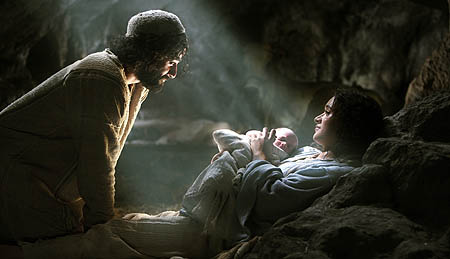
The Nativity Story

I took a break this week, fleeing to Bay Fair Cinemas to seek multi-medi-c inspiration in watching the recently recent movie "The Nativity Story." It was a nice surprise. The filmmakers tell the story in a most understated and gentle way, as opposed to the over-the-top-gratitutiousness that marked The Passion of Christ (at least for me). What most struck me in the film was the fantastically realistic and accurate way in which it portrayed the desperation and waiting of the people during the reign of Herod under the Roman Empire in ancient Palestine. The people were poor, oppressed by their own collaborating King, forced to pay taxes they couldn't afford in order to build fortresses for their King. Throughout the film there are depictions - both visible and implied - of what happened to those that questioned Herod's authority, spoke out to express their hope and need for a Messiah King, and the reality that all power resided in the hands of the Empire and those that served it. In the film the actors are dirty, brown skinned (check out a recent site I found and theo-design work being done by friend Steve Baretto), live in poverty, and live in great fear of the Roman soldiers, King Herod and even each other.

I found the repeating line that the baby would be "the king of kings for the lowest of men to the highest of kings" to be an appropriate catch-phrase for articulating the theological and political undertones of the whole Nativity story found in the Gospels of Luke and Matthew. I loved the portrayal of the shepherds - the ultimate overlooked social outcasts who end up being the first to hear of the good news and to come and greet this anointed child.

The movie is great for showing the harsh reality of daily life, the historical context for the birth of Jesus of Nazareth, and giving a glimpse of the desperate hope and ardent longing for the Messiah to come and deliver the people. There is also a great depiction of the young-age and all the consequential character development of Mary who was an early teenager as opposed to a middle-aged-botticelli-looking-madonna.

Check out the movie trailer at the official movie site http://www.thenativitystory.com/

Tuesday, December 12, 2006

Advent 3c Texts for Worship
December 17, 2006
LOVE

This coming Sunday is the 3rd Sunday of Advent - the theme of which is LOVE. I googled LOVE and saw a stream-of-consciousness collection of images of and about love - marriage, babies, puppy love, a picasso painting of "Love and War," art, roses, all the cliche stuff - as well as dozens of photos of Jennifer Love Hewitt. But what is LOVE - is it weak? strong? Who gives it to who? - parents to children, children to parents, lovers to each other, neighbors when they're feeling neighborly, work colleagues when they need something? How can you see love - to know if it's the real thing? How can you tell how much another loves you? How can they tell that they love you? Where do we even learn the capacity or the tendency to love another besides just loving ourselves?


The scriptures for the day are Zephaniah 3:14-20, Isaiah 12:2-6, and Luke 3:7-18.

Zephaniah writes about God's love - God's presence in the midst of the people - like a warrior that changes the people's shame into praise, their un-knowness into renown throughout all the nations, brining Home the outcast and lame. It's a total transformation of the state of God's people from nothing, on the margins, easily-forgotten people into the people of the way, in the center, proclaiming and making life-meaning for others. God does it for them.

Isaiah is a song of joy, praise, and love. God is to poet's salvation - saving love that he knows here and know - saving love that changes everything - reframing everything - opening new doors - giving new energy - creating new life from the old (like a phoenix rising from her ashes).

Luke 3 tells of the preaching of John the Baptist calling his audience to radical transformation because of God's love for them. It's a transformation that doesn't have to do with simplistic morality or politeness, but an invitation to an awesomely different way-of-living-ethic, to the extent that what the people are called to become and do can only open the eyes of those they encounter to the miraculous transforming power of love. John is calling folks to discover and deepen their practice of sacrifical love - a love that Jesus will teach them about in his words, actions, and life-giving-death.

So what is LOVE - where did you learn it? Who taught you to love? How do you love? Does it even matter? Do we have to love like James Kim in order to truly know love? What does sacrific have to do with love? Can you love with out sacrifice?


Saturday, December 09, 2006

Can I Get a Witness,
Or At Least a Play Date?


I was driving home from pre-school today with my daughters and a friend (all under 4 years of age). As we drove through Oakland, they scoured intensely the horizons of their view for any spot of Christmas Decorations. As we drove my daughter talked about a nearby neighborhood church building, covered in an explosion – very much over the top – of Christmas lights, mangers scenes, and illuminated palm trees. She exclaimed with glee that if we went there we’d have the chance to see the “Holy Family” and the other statues there – including a grown-up baby Jesus. The friend asked who Jesus is, and my daughter responding matter-of-factly saying, “you know,… the Son of God.”

I chuckled as I drove listening to this dialogue…smiling at the cuteness of the situation and then wondering about the context. Is it because they’re children that they can talk so matter-of-factly about faith, spirituality, and discipleship? Is it because they’re minds are simple and they can’t measure the potential awkwardness of their discussion in our pluralistic world and culture? Or is there a freedom and grace that we lose as we get older? And if we do lose such a grace is it by our choices of non-freedom or fear of rejection, or is it because we complicate the world more than it needs to be?
I'm struck by the fearlessness that my daughter showed in her comments and reactions. She was fearless, because she had nothing to be afraid of. It was a conversation among friends, sharing their perspective, talking with not just to one another. How often do we - do I - think or feel similar things when I'm talking about my faith or the ways in which I practice my spirituality? If there is some sort of freedom or grace that we somehow lose as we age, it most likely is the freedom to allow ourselves to be ourselves without fear of rejection, judgement, or some sort of self-loathing.

Tuesday, December 05, 2006

Advent 2C
Texts for Worship
Second Sunday of Advent
December 10, 2006
PEACE

The theme of this second week in Advent is PEACE. The three scriptures I'm meditating upon and through this week are Malachi 3:1-4, Luke 1:68-79 and Luke 3:1-6, I'm thinking about peace - and wondering what it is. On TV this week the new Holiday GAP ad is highlighting PEACE as a hip-hop background for their massive multinational selling of hip clothes. At the same time for some diverse and different people with whom I've spoken this past week PEACE is "getting out of Iraq," for others it's "staying the course in Iraq," for some concern about Beirut, Palestine, Youth Violence in Oakland, or family members suffering from Cancer. What is it about Peace? I've noticed in the past two years that it's a lightening-rod word that quickly forments polarizing positions-taking wether on the liberal or conservative side of things. But what do the Christian scriptures testify about in terms of PEACE?
This week the words from the prophet Malachi (the first passage) are about the Prophet-Messenger that will come to prepare the way for God, when God shall come in the future to his temple. This messenger will announce a day of judgement or refinement - much like precious metals are made more precious and beautiful in a refiner's fire. Such a "refined" or "purified" priesthood-people is the way that God wants and longs for his people to be in Malchi's time (and ours too) in such a way that their offering - the way they live every moment and aspect of their lives - will be pleasing to God.
The second passage - Luke 1 - is the song of Zechariah, song after the miraculous birth of his son John who will become the great prophet (foretold by Malachi according to Christian tradition), the Baptist who prepared the way for Jesus of Nazareth, through his call to conversion and openess to a new way of life. Zechariah talks of the work of the Lord who will lead the people into life from death, light from darkness, guiding our feet into the way of peace. John is only who he is created and meant to be in relationship to Jesus - the one he comes before and for whom he's preparing the way. It's not his crazy haircut, avant-garde clothes, or apocalyptic preaching that make John unique. It's his relationship of interdependency, mutuality, and reciprocity with Jesus of Nazareth, that make him John the Baptist. This way of peace is a journey-path meant for a community based upon and through relationship with this mysterious man from Nazareth.
The third scripture (Luke 3) tells of the beginning of the minsitry or teaching of this John the Baptist. Peace for John is the prepartion of all humankind to see (experientially, philisophically, materially, spiritually, and emotionally) the salvation of God. A SHALOM peace of community in which all are invited to the table by God. (Check out Isaiah's word-vision of this in chapter 2 of his prophecies.) It makes me wonder even more. Peace for most of us is peace-and-quiet, peace from the daily routine, more of a "break" from life, a personal time-out when we get what we want when we want it. But these scriptures (and all the testimonies of the Bible) paint the picture of PEACE as a communal thing, more of a fullness-of-life than a break from it, more of a deeply proactive and participatory thing than a passive individualistic lawn-chair-on-a-deserted beach-vacation-break. Why is it that in our culture when we imagine PEACE it's often so individualistic and me-centered? In the midst of this I'm reminded of two things:

First the Hymn Finlandia - the national hymn of Finland - and words that were written to the melody (we recently sang this at our church) Here is here.

Lloyd Stone wrote an international version of the lyrics in 1934

This is my song, Oh God of all the nations,
A song of peace for lands afar and mine.
This is my home, the country where my heart is;
Here are my hopes, my dreams, my sacred shrine.
But other hearts in other lands are beating,
With hopes and dreams as true and high as mine.

My country's skies are bluer than the ocean,
And sunlight beams on cloverleaf and pine.
But other lands have sunlight too and clover,
And skies are everywhere as blue as mine.
Oh hear my song, oh God of all the nations,
A song of peace for their land and for mine.

Another verse by Josh Mitteldorf, for difficult times

When nations rage, and fears erupt coercive,
The drumbeats sound, invoking pious cause.
My neighbors rise, their stalwart hearts they offer,
The gavels drop, suspending rights and laws.
While others wield their swords with blind devotion;
For peace I'll stand, my true and steadfast cause.

A verse by Georgia Harkness

May truth and freedom come to every nation;
May peace abound where strife has raged so long;
That each may seek to love and build together,
A world united, righting every wrong;
A world united in its love for freedom,
Proclaiming peace together in one song.
And second, words of Jesus of Nazareth in John 14:27

"Peace I leave with you;
my peace I give you.
I do not give to you as the world gives.
Do not be troubled and do not be afraid."
How do you imagine peace? What would it look like? What does it looke like? When have you felt most at-peace? Share your thoughts and stories on the blog to help in the sermon creation and discussion at Fruitvale Church.

Saturday, December 02, 2006


Exprience>Information?
LIFETHEOLOGYARTWORSHIP

A pastor friend, Matt Prinz, recently gave me an article on The Art of Olafur Eliasson, "Seeing Things" from the New Yorker Magazine (11/13/06). I'm not as savy and conversant in terms of the Art World as Matt is. It turns out Oalfur Eliasson is quite the current (and recent past) sensation in the world of Art.

Eliasson seeks to create an experience through his art, to invite us to reconnect with the larger world that we often take for granted, through an intense and intentional exprience of the world through his installations. In the article he talks about a show he was installing for the Tanya Bonakdar Gallery in Chelsea. Commenting on the show in the New Yorker interview he said "A show like this comes out of the laboratory. It's not about foil and water. It's about how we feel about those things. The pool is a machine that can produce a phenomenon, but I'm very aware that it can come close to being a setup. ... Working on the idea of experience is something intimate. Speaking with you, now, will change the way I see when I return to the gallery." Of course for some critics the verdict is still out in regards to whether or not Eliasson's work (like dumping non-toxic substances in a river in Sweden in order for city residents to (re)become aware of the beauty and movement of the river in their midst) can really count as "art" in the traditional sense of the word.

Eliasson's comments and vision of art made me think about worship and the church. It also reminded me of one of the widely-published thinkers of the Emergent Church - or Post-Modern Circle of Thought - in Contemporary American Chrisianity: Leonard Sweet. Sweet talks about The epistemology of digital culture, offering an acronym for that in the word EPIC: E=experiential; P=participatory; I=image-rich; C=connective. His thought is that worship in a postmodern context has to prioritize the digital culture in which we live. One of the main aspects of his thoughts intersects with much recent philosophy (Paul Ricoeur for example) and the work of Eliasson (experience his art at the SF MOMA next Fall - it'll be a major survey of his work entitled "Take Your Time: Olafur Eliasson).

All this makes me wonder about Christian Worship. Often I've been to worship services which were much more about information than about experience. Worship was focused on what it intellectually means to be a Christian, than enabling me to practice my faith in discipleship. They were more like a "how-to-succeed" seminar or a group-therapy-session-of-encouragement, than some sort of communal gathering aiming to experience as a gathered community the presence, purpose, and passion of God. I think worship is more about providing consistent, intentional experiential celebrations of God's nature, purpose, desires, grace, and call to community - all hoping that God's Holy Spirit will show up to transform our best intentions into a living experience of God. The worship celebrations I remember were such experiences of hopeful anticipation, eye-opening celebration, and life-transforming revelation.

Some might say that like Eliasson's work, such experiential worship is more of a subjective or ego-driven stunt than a meaningful and meaning-making service of worship. Does experiential-ness trump information? Or is it just a gimmick?

What experiences of God have you had in a worship setting? How are/were they different than other experiences of the Divine that you've had outside of a formal worship setting (like in nature, daily life, or through art)? How do you think an emphasis on "experience" might be enriching or distracting to our traditional form of Worship in the Reformed Tradition?

(Image Credits - in descending order
1. The Kaleidoscope - Rostock, Germany
2. The Weather Project - London, The Tate
3. Double Staircase - Essen, Germany

More Images of his work at flickr