Showing posts with label Moving beyond the Book of Common Worship. Show all posts

Wednesday, June 10, 2009

Does anyone know what it all means?

I'm at a young clergy conference in Montreat, N.C. [Alt7] this week. Much dialog happened today about the changing world in which we are living, the future world that is emerging in the midst of our current context. Extrapolated to correlate to the role, purpose and style of the Presbyterian Church (let alone any church) can either be terrifying or exciting - or both - for people such as myself ordained, or called, or committed to working in the church, serving her here and now as pastors. What does it all mean for the future? Rapid change. Unsure futures. A majority of now dominant churches that will die with their members and the disappearance of the decreasing worldviews that they move in. The reality that most clergy positions will not be full-time, or like what we've been used to. In the end I'm left at the end of the day with our position: in times of change we grasp for the familiar, the easy the seemingly replicatable. Yet in change those are the very options that become obsolete, irrelevant and dangerous.

I received this video in an email today, it points out the rapidly changing things about our world asking the question: "does anyone know what it all means?" We all interpret that question according to our context. In wondering what it means for mine I'd have to guess that it means moving beyond what we know and do today, to risk practicing something different - not for different's sake - but with an experimental attitude about how we can address the rapidly changing, continually emerging and bifurcating world of old and familiar with new and untested. Maybe fear is the only option not to put on the table.


Sunday, January 13, 2008

Experiential Art & Postmodern Worship
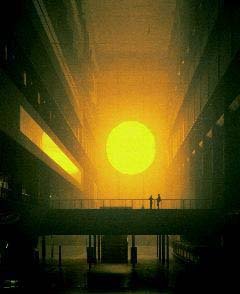
Olafur Eliasson, Take Your Time & You

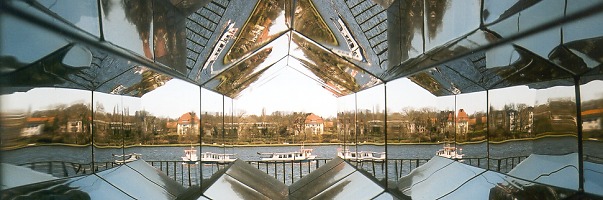
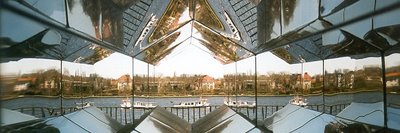
I went with some friends to view a fantastic exhibit at the SF MOMA this past week entitled "Take Your Time" by Icelandic artist Olafur Eliasson. I've blogged in the past about him and his work and how it can inform the ways in which we understand many things, in particular for me Christian Theology, Worship and the practice of life in a church community. It was amazing! I'm grateful for Susannah and Matt and how they introduced me to this material.

If you're part of the Presbytery of San Francisco, please join us for a discussion involving and integrating this material in terms of the practice of church on Tuesday, January 15th at Sojourner Truth Presbyterian Church from 1:30-2:30pm.

If you can't (or even if you can) join that discussion do go and see the exhibit at the MOMA through the end of February. Here's some pictures I took as well as some reflections from the art, our conversations there and observing the interaction of all those in the museum.


1. We think there has to be an "expert" in everything who guides us and teaches us at the same time. Eliasson's art deconstructs that so that we all are the experts gathered as a community by a common experience. It changes the discussion and dialogue from the expert and us, to us about who we are and what is happening. That's what Christian worship should be more like, as opposed to an expert (clergy person mostly) who does most of the talking seeking to impart information as opposed to facilitate experience, participation and connection.

2. We think that we have to explain everything, but deconstruction is something we all can do and join in. Eliasson deconstructs the simplest natural elements (water, light, moss) so that we might have a new perspective on what life is about and like. Jesus did that all the time. It's what his teaching was about, and what made it so powerful, deconstructing everyday life, exposing the way in which we live, relate with one another, understand ourselves, seek power, serve others, and love God - so that we might become aware of the disconnect between who we think we are and who we are, and how things are and how God longs for them to be. That's what the gospel is both about and what it does when it's proclaimed. I don't think I ever experienced that on a Sunday morning. How come?

3. We spend so much time telling others (in particular children) to "Be quiet!"; "Don't touch!"; "Keep moving!" that we all miss out on the life all around us. The Moma was filled with kids. They wanted to touch things (which Eliasson intended them to do), to make noise as they responded to the beauty of the installations (which Eliasson intended them to do), to physically express their jubilant intellectual curiosity in their own language. Repeatedly many of these kids were told by their teachers, parents, and even some of the museum staff - don't touch! be quiet! keep moving! All of which are completely counter to the experience driven exhibit that seeks to involve observers as participants in a new community. How can you do that from silent, passive distance? The kids were articulating what we all felt. They were much freer to do so yet folks shut them down so that they'd conform to our grown-up norms. We do the same thing in worship and church communities. We talk about participation and community but we're actually terrified of it. That goes not only against the central word of the gospel, it's actually the un-gospel of Jesus of Nazareth.

Have you seen the exhibit? What struck you? How?

I have a great article from the New Yorker (Nov 16, 2006) about Eliasson. If you'd like me to email you a copy leave me a note with your email.

Saturday, December 02, 2006


Exprience>Information?
LIFETHEOLOGYARTWORSHIP

A pastor friend, Matt Prinz, recently gave me an article on The Art of Olafur Eliasson, "Seeing Things" from the New Yorker Magazine (11/13/06). I'm not as savy and conversant in terms of the Art World as Matt is. It turns out Oalfur Eliasson is quite the current (and recent past) sensation in the world of Art.

Eliasson seeks to create an experience through his art, to invite us to reconnect with the larger world that we often take for granted, through an intense and intentional exprience of the world through his installations. In the article he talks about a show he was installing for the Tanya Bonakdar Gallery in Chelsea. Commenting on the show in the New Yorker interview he said "A show like this comes out of the laboratory. It's not about foil and water. It's about how we feel about those things. The pool is a machine that can produce a phenomenon, but I'm very aware that it can come close to being a setup. ... Working on the idea of experience is something intimate. Speaking with you, now, will change the way I see when I return to the gallery." Of course for some critics the verdict is still out in regards to whether or not Eliasson's work (like dumping non-toxic substances in a river in Sweden in order for city residents to (re)become aware of the beauty and movement of the river in their midst) can really count as "art" in the traditional sense of the word.
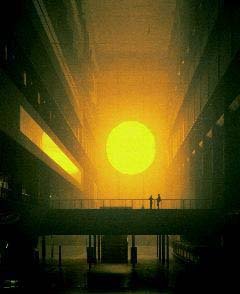
Eliasson's comments and vision of art made me think about worship and the church. It also reminded me of one of the widely-published thinkers of the Emergent Church - or Post-Modern Circle of Thought - in Contemporary American Chrisianity: Leonard Sweet. Sweet talks about The epistemology of digital culture, offering an acronym for that in the word EPIC: E=experiential; P=participatory; I=image-rich; C=connective. His thought is that worship in a postmodern context has to prioritize the digital culture in which we live. One of the main aspects of his thoughts intersects with much recent philosophy (Paul Ricoeur for example) and the work of Eliasson (experience his art at the SF MOMA next Fall - it'll be a major survey of his work entitled "Take Your Time: Olafur Eliasson).

All this makes me wonder about Christian Worship. Often I've been to worship services which were much more about information than about experience. Worship was focused on what it intellectually means to be a Christian, than enabling me to practice my faith in discipleship. They were more like a "how-to-succeed" seminar or a group-therapy-session-of-encouragement, than some sort of communal gathering aiming to experience as a gathered community the presence, purpose, and passion of God. I think worship is more about providing consistent, intentional experiential celebrations of God's nature, purpose, desires, grace, and call to community - all hoping that God's Holy Spirit will show up to transform our best intentions into a living experience of God. The worship celebrations I remember were such experiences of hopeful anticipation, eye-opening celebration, and life-transforming revelation.

Some might say that like Eliasson's work, such experiential worship is more of a subjective or ego-driven stunt than a meaningful and meaning-making service of worship. Does experiential-ness trump information? Or is it just a gimmick?

What experiences of God have you had in a worship setting? How are/were they different than other experiences of the Divine that you've had outside of a formal worship setting (like in nature, daily life, or through art)? How do you think an emphasis on "experience" might be enriching or distracting to our traditional form of Worship in the Reformed Tradition?

(Image Credits - in descending order
1. The Kaleidoscope - Rostock, Germany
2. The Weather Project - London, The Tate
3. Double Staircase - Essen, Germany

More Images of his work at flickr