Thursday, November 30, 2006

Advent Letter to a Christian Nation
- An editorial from Monte McClain –


The current best seller nonfiction book list contains two books written by atheists challenging the practice of religion, asserting that it actually contributes to turbulence, turmoil and terror in our world as opposed to spreading peace, community, and unity. The God Delusion (Richard Dawkins) and Letter to A Christian Nation (Sam Harris) are challenging challenges to the belief, practice and worldview that shape our lives as disciples of Christ as well as that gather us into a community of faith. As I read the latter, I found myself wanting to shout out, “but… I don’t live my faith like that!” What was described and criticized in terms of Christian doctrine, dogma, and political stance only hints at describing a part of the larger diversly different Christian Community in our United States.
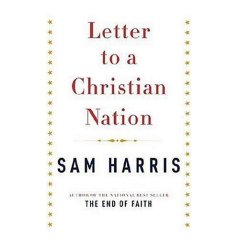

These books were written to a supposedly Christian nation in order to share the atheist perspective on what is happening in our world, both near and far. The books address a Christian nation that affirms its Christian belief in the ever-advancing selling date of
Christmas Decorations (even before Halloween this year), forces disciples of Christ to hide their brokeness in ways that lead to hypocrisy like we see in the example of Ted Haggart, and that seek to proclaim their political importance through involvement in both principal political parties both of whom seek ardently to position themselves as the “voice” of the Christian establishment and culture (not to be faithful as much as to convert more undecided voters). Yet Jesus of Nazareth was born in total poverty, far from the WalMart-wars-of-welcome at Christmas time that might return this season. Jesus attacked the hypocrisy of the religious establishment of his day by lifting up such models of faithfulness and faith-full living as the poor widow, the Samaritan, and overlooked, expendable little children. Jesus commented consicely on the politics of empire by saying that one should give to Ceasar what is Ceasar’s and to God what is God’s. It seems to me that we spend so much time fighting over which and what “neighbors” we are willing to love, that we rarely get to actually loving our neighbors as Christ loved us. As I ponder the approaching of Advent I’m struck by the reality that the man – we believe to be the King of Kings, the ultimate Savior of all the Universe – was born in a needy world characterized by imperial wars and nation building, ethnocentricism, racial oppression, and an emerging world order in which the mega-rich were the super-powers of the known world. Is our time and world really that much different than Nazareth, Bethelehem, and Rome were 2,000 years ago? Are we really that different than the inn keeper that had no room for the young couple expecting a baby that night, or the outcast shepherds who dared to wander into town to see if they rumor that they’d heard in the fields was really true, or just too good to be true?

As I think about those books in the best seller list, I wonder if we really are living in a Christian Nation. Maybe we are. Maybe we are just in “name’s sake.” My response to those books would be to seek to engage in a discussion with their authors, or to sit down and talk with people that might share similar criticism or perspectives. In our culture today we’re so quick to be polarized to see things in black-and-white, and to rapidly decide that we’re right and they’re wrong. These politics of polarization seem to only add to our unchristianess. Jesus wasn’t wishy washy or a relativist, but the only time I remember him drawing a line in the sand in a discussion over a topic was literally when the woman was brought to him caught in adultery, and when he overturned the tables in the Temple. Maybe we all – myself included – often forget who and how Jesus really was. Maybe we have let our culture invade our minds and imagination so that when we imagine Jesus as the Messiah we give him the cunning of James Bond, the mind of Bill Gates, the looks of George Clooney, and the political views of the Bush or Clinton families. I fear that, oftentimes we forget that Christian and Capitalism aren’t actually the same thing. We overlook that Jesus was more interested in transformation than power, in people than policies, in giving hospitality, compassion, and grace than he was in receving it. May these next four weeks of Advent be a chance of reflection, renewal, and reversal of the ways in which we see, know, and experience our Christian discipleship and practice our spirituality – whether we live in a Christian Nation or not.
Peace to you and yours,
Monte

Monday, November 27, 2006

ADVENT 2006


Advent is the time consisting of the 4 Sundays prior to Christmas. This year the First Sunday of Advent is Decmeber 3rd and the fourth and final Sunday is December 24th. Traditionally it was a time of prepration leading up to the good news of Christmas. The liturgical or church colors are either purple or blue (symbolizing "royalty"). One of the celebration rituals includes lighting a candle of the advent wreath each of the 4 Sundays of Advent, with the fifth candle or the "Christ candle" being lit on Christmas Eve or Day.


I actually prefer Advent to Christmas because it's about preparation, waiting, process, the mystery of seizing an unbelievably-too-good-to-be-true promise in the midst of the tensions, turmoil, and goodness of daily life. Our daughters have an Advent Calendar made by Playmobil. Each day in Advent they open a box - receiving a toy of course - but it shapes the time. It might just be a ploy to teach morality such as patience, perseverance, and anti-greed; but I think it teaches them and me of something bigger and deeper. Life without an ultimate goal, telos, or promise is empty. It's like a boat drifiting without a destination. Advent reminds me of the promise that shapes the way in which I see life, meaning, and the universe.

Here's some online Advent Calendars I'm checking out this year....hope you enjoy
Up to Ten (kid friendly with games!)
Information regarding Advent


Advent 1 C - Texts for Worship -
December 3, 2006
@ FVPC
HOPE

The texts for this next Sunday - the first in Advent - are Jeremiah 33:14-16, Psalm 25:1-10, 1 Thessalonians 3:9-13 and Luke 21:25-36.


The four scriptures for Sunday all talk about Judgement. The more-than-four-letter-word that strikes a chill in us at its hearing and motivates some in their violent striking-out against others. What is Judgement? Linguistically the words means more or less to separate, to sift, to distinguish one from another. Philisophically it's not a word that evokes images of dancing devils with pitchforks, planes crashing into skyscrapers, or the "righteous" celebrating at the downfall of the "heathen."

Judgement Day is a moment in time in which things change. The Jeremiah passage talks about it as a great HOPE, a redefining and redeeming moment to come. The Psalm talks about the steadfast faithfulness of God, and the poet's desire to grow spiritually in wisdom, practice, and godliness. 1 Thessalonians talks with hope about the coming of the Lord. While Luke portrays more of an end-of-the-world perspective to the Day of the Lord, urging us to stay alert, or remain awake so that we might not live our lives in a passive slumber, but rather in a pro-active, participatory path of faith, peace, and mission. So this first Sunday of the Christian Liturgical year begins in HOPE, rather than the regretting-the-past New Year's Resolutions that we promise to uphold on January 1st each year.

So what is judgement day? What do you think? Is it literal? Is it a metaphor for something else? Why do we begin Advent - the Christmas Season - with such a depressing and dark topic? Do you like to talk about it? Why or why not?

Tuesday, November 21, 2006

Power Reveals & Transforms Us:
Worship Text for Sunday, 11/26

I read an interesting article in the Chronicle this past Sunday (Power is not only an aphrodisiac, it does weird things to some of us) on power and its power on our relationships.

The articles is based upon an observation by Robert Caro that "power doesn't corrupt, it reveals." Power reveals our true natures, our deepest fears and suspicions, and brings into light our most-real selves. It's like a mirror that reveals through reflection how we really look. The article goes on to say that "power not only reveals but also that it changes people." Quoting several sociological and psychological studies in which this reality is exposed through scientific observation, the point is driven home. What I heard is maybe that we're not corrputed by power, but rather that power reveals our deep corruption we often seek creatively and actively to hide from others out of some sort of morality, or fear of social rejection, or out of a terror of who and how we really are. What also struck me was that thought that maybe the absence of power also reveals who we really are.

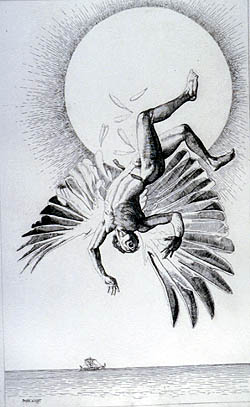
The article mentions the Greek myth of Icarus, who intoxicated by his newly found power to fly, disobeys his father in their flight from certain doom, and flys too close to the sun thus ensuring his own death. It seems that we see that over and over - wether that's in the political sphere, in our celebrity-driven culture in which articles in People and US Weekly seem to be the most consistent form of social-gossip truth-telling that characterizes our national conscious today, and even in our own personal lives and relational spheres. Power reveals who we really are: wether it's the power of becoming speaker of the house, a member of a church committee, or someone who is given a key and asked to be "in charge" of something. I find that I see it nearly every time that a ask a child to be in charge when I leave the room temporarily at the Preschool I work at weekly. Some kids don't react differently, but do reveal a pride of being in charge. Others will quickly - nearly instantly - become bossy. What is it that makes us be like that? The testimonies of the Bible point to our inner (and outer) brokeness, calling it sin.

This Sunday's text for worship (John 18:33-37) lifts up the power encounter and discussion between Pontius Pilate and Jesus of Nazareth during the latter's arrest. In Pilate's efforts of interrogation he's lead to ask, "What is truth?" of the one he's to judge. Both are trapped in a sense by their contemporaries, the cultural situation that characterizes them, their life-stories, and their social position on the "power" ladder. Pilate is in charge - expected to judge and execute Roman justice. Jesus has no power and yet through conversation reveals the hearts of all those that he encounters. Jesus seems to know what the outcome will be, Pilate is still unsure, pressured by his context to do one thing but expressing interest in making an opposite choice. The power that they have reveals who and how they are.

This coming Sunday - November 26th - is traditionally called "Christ the King" Sunday - a day in which we seek to fathom and put into practice the world-transforming ways in which Jesus of Nazareth was a king, sought power, and used it. What do you think? Does power reveal who we are? What have you experienced or observed? How does this passage from John - Jesus' trial and crucifixion - address the idea that "power reveals"?

Monday, November 13, 2006

Let It Ring

This past week has been a russian mountain rush. (In French a roller-coaster is called a montagne russe). A roller-coster package of days between the revelation of the hypocrisy of many Christian communities and leaders, a strong election-population acclamation for change, and some tumultuous events and words in my own life. I think I was ready to "get off" the ride several times - eager to quit most everything - but my family - in my life through these twists, turns, and tempests. In a week in which Christianity - the faith world-view of personal and global transformation I base my life upon - made the covers of both Time and Newsweek, I found myself questioning why I would associate myself with a community that seems to do/be the opposite of what it claims as its founding ethos. Is it any surprise that our church's are emptying and growing older by leaps and bounds, while most people my age prefer Starbucks to a Sanctuary, or Pete's to a Purpose-Driven Church?

Just as I was nearing one of the existential drops of my last days I was blessed to go with my wife to a concert of our favorite muscial group, a spirtual gathering of music-loving, left-leaning, world-changing folks looking and longing to here some sort of transcendent voice in the midst of the oppresive, military-complex, modern-dualistic, increasingly irrelevant world in which we dwell, live, and minister. Amy Ray of the Indigo Girls recently created her second solo album, Prom, which contains a song that I find rings radically relevant in terms of the self-sufficient righteousness of much of modern American Evangelical Christianity. It might have been just me - the midst of the crowded concert hall - that had an existential "God Moment" in the singing of on of my increasingly favorite songs (or maybe I wasn't alone? there were a lot of screamers - singing at the top of their lungs with me?). It sounds corny - but I left ready to "let it ring" for what I seek to practice by God's grace in my own life, decisions, relationships, and words.

"Let It Ring" from PROM
Amy Ray

When you march stand up straight.
When you fill the world with hate
Step in time with your kind andLet it ring
When you speak against me
Would you bring your family
Say it loud pass it down andLet it ring
Let it ring to Jesus
‘cause he sure’d be proud of you
You made fear an institution and it got the best of you
Let it ring in the name of the one that set you free
Let it ring

As I wander through this valley
In the shadow of my doubting
I will not be discounted
So let it ring

You can cite the need for wars
Call us infidels or whores
Either way we’ll be your neighbor
So let it ring
Let it ring in the name of the man that set you free
Let it ring

And the strife
will make me stronger
As my maker leads me onward
I’ll be marching in that number
So let it ring

I’m gonna let it ring to Jesus
Cause I know he loves me too
And I get down on my knees and I pray the same as you
Let it ring, let it ring
‘Cause one day we’ll all be free.
Let it ring

I also loved hearing the opening song that my daughter performed for her youtube debut. (We're hoping she'll become the Third Indigo Girl) Enjoy the video here!

Monte

Monday, November 06, 2006

Dia de los Muertos

In our worship celebration yesterday (11.05) at Fruitvale Church, we celebrated Dia de los Muertos, or All Saints' Day, in builidng an altar and placing picutres of loved ones that have died and gone before us into the mystery of God's Kingdom.The scripture passage upon which we reflected comes from Mark 12:28-34, in which Jesus teaches the essential link between how we love and serve God, and how we love and serve our neighbor or each other.

I was struck by the photos that had been lovingly placed with great care on our Day of the Dead altar - the memories that they evoked, the relationships that they symbolized, the blessing that those lives had been - and continue to be - to those that brought the photos.


If I slow down long enough, I'm able to create my own photo-album in my mind of the many people that have blessed me (wether they're dead or still living) through their friendship, mentoring, kindness, friendship, love, generosity, humor, or time.Loving you neighor as God loves us is in a sense paying what we want to give back to God out of generosity forward. In a similar, yet reciprocal way, I find that I often want to give grace and thanks back to God for the love that I've received for others. That's what it means to be "blessed," and to have a "bless'd day." How is it that you have been blessed by God or others? How do you "pay that forward" or pass it on?

Monte

Thursday, November 02, 2006

What's Your Theological Worldview?
Who's Your Inner Theologian?


Taken the test and see who you are?
http://quizfarm.com/test.php?q_id=43870

Here's my results of the quiz...

">You scored as Emergent/Postmodern. You are Emergent/Postmodern in your theology. You feel alienated from older forms of church, you don't think they connect to modern culture very well. No one knows the whole truth about God, and we have much to learn from each other, and so learning takes place in dialogue. Evangelism should take place in relationships rather than through crusades and altar-calls. People are interested in spirituality and want to ask questions, so the church should help them to do this.

Emergent/Postmodern

100%

Roman Catholic

71%

Neo orthodox

68%

Charismatic/Pentecostal

68%

Evangelical Holiness/Wesleyan

64%

Modern Liberal

50%

Reformed Evangelical

36%

Classical Liberal

32%

Fundamentalist

7%

http://www.blogger.com/'>What's your theological worldview?
created with http://www.blogger.com/'>QuizFarm.com

Wednesday, November 01, 2006


Enjoy these photos of the Halloween

Parade and Party

@ Peter Pan Coop!

God's Community - Where Is It?

I find the more that I work as a pastor the more I discover that my work is more about people than God, more about creating relationships than about claiming to have an “authoritative” relationship with God that others should imitate or emulate. Community is the thing that seems to characterize my days, time, and passion. Church is a sense is mostly about community, a gathered community of diverse and different people gathered together because of their common and shared Christian faith that we know God is a unique and life-transforming way in the person of Jesus of Nazareth, his life, teachings, death and resurrection. It’s this community that is the subject and object of my thoughts, dreams, vision, and time. How do we build up a community of people that share faith and a transformative experience of God’s presence, but might not share any sort of political belief, socio-economic status, cultural background, generational perspective, or technological resources? Doing this seems to involve me as much working within the relational web of our church community, as well as working and living outside of that paradigm in the connections in the community surrounding our church: the neighborhood watch groups, merchant associations, improvement associations, school communities, and community organizations that characterize and shape the neighborhood in which our church building is located.

What I find ironic is that historically the church has thought and acted in such a way that they presumed that they alone were the community through which God became known, or acted in the world. What I find paradoxical is that in my community-building presence and work I find that God seems to be moving, creating connections, and birthing new possibilities for community as much within the church as outside of it. Why is it that we often think in terms of insiders and outsiders when we think communally? I’m consistently marveled by the work and relational presence of the people around me – seeing how the God I believe is at the center of all life creating, sustaining, and resurrecting us is truly at the center of all of life creating new relational connections, sustaining individuals longing and working for a better world, and resurrecting or transforming dreams, efforts, and commitments to something bigger and deeper than a temporarily satisfied-consumeristic vision of daily life.

In our Oakland community I repeatedly experience God in many ways…..one of my recent “sacred experiences” was on Saturday, October 28th at the Dimond District Halloween Parade for children and pets. Ruth Villasenor & Diane Pfile owners of Paws and Claws have a local pet-store business that operates just as much if not more as a community center. They use their community relational connections as a way to build community, bringing people together, and creating new potential and possibilities for our area of Oakland through information, community campfires , local peace vigils and this recent Halloween Parade.


As a follower of Christ, I find that I experience the power and presence of God in such relationship building connections and gatherings….God is at work in our part of Oakland within our faith communities, but just as much (if not more) in our communities through faith – faith in the Divine Presence, and in the power of relationships. In his letter to the ancient church in Romans the apostle Paul writes that "all of creation is eagerly longing for the revealing of the children of God" Why is it that the church so often and easily forgets that God doesn't belong to the church, but rather that God invites us to be church in the world?

Thursday, October 26, 2006

Web-o-life: We are not our own
An editorial from Monte McClain – Pastor, Fruitvale Presbyterian Church


Self-Reliant.

Self-Differientated.

Self-Sufficient.

Self-Indulgent.

Self-Made.

Self-ish.


We live in a world in which the “self” is our defining identity. Driven by an intense drive and desire for independence, we affirm and assert that we are ourselves the ones that planned, created, facilitated, or empowered whatever is happening around us or in us. At the same time we feel more and more alienated and powerless in a world in which major decisions are made by the uber-rich in board rooms or politicians born into trust-fund universes, in which everything we wear, use in our home and increasingly even eat comes from a distant country. Our post-modern world of the early 21st century is one in which we are shackled by the dominating drive for independence and self-sufficiency from the past, and yet the dawning hope of such forces as community, connectionalism, and corporate solidarity are rising upon what we know, kindling in us a desire for something else.

This past month I’ve been haunted by lingering and emerging thoughts about who I am and why I do what I do. I think it comes from the Sunday morning in which we created what David Kittams called the “web-o-life” in worship, in order to give a visible image of our community and hope in God’s presence (see photo). I live – like we all do – in and from that web. Who I am today is in part the result of some of my choices, but it’s also in great part due to the influence, presence, and mentoring of others.

When I slow down – both calendar-wise and mentally – I’m able to pass the pictures of those people that taught me, built me up, and invested in me through their relationships, through my mind’s eye. Try it! Who taught you to ride a bike, to say “thank you”, influenced and shaped you in your profesisonal life, encouraged and equipped you in your faith, nurtured your spirituality, taught you about the mysterious mutual and reciprocal aspects of love and relationships? In doing so, I realize that I am not my own; that we are not our own. I am both independent, and also dependent on others. I am not my own. Those who loved, invested in, and equipped me, did so out of love and in generosity, and I in turn am called to pass their faithfulness on, to pay it forward, to recognize that I am part of the intricate “web-o-life,” to be a good, generous, and gregarious steward of what has been given to me. My parents, teachers, friends, mentors, church community – and God in Jesus, have shaped what I do, how I do it, and mostly who I am today. My stewardship and faithful paying-forward of my blessings through my time, passion, money, and gifts is how I actively say “thank you” to them and continue building that giant web connecting all of creation to the life-giving God that makes it all possible.

The apostle Paul wrote this same “web-o-life” message in other words to the troubled church of Corinth, “I give thanks to my God always for you because of the grace of God that has been given you in Christ Jesus, for in every way you have been enriched in him, in speech and knowledge of every kind— just as the testimony of Christ has been strengthened among you— so that you are not lacking in any spiritual gift as you wait for the revealing of our Lord Jesus Christ. He will also strengthen you to the end, so that you may be blameless on the day of our Lord Jesus Christ. God is faithful; by him you were called into the fellowship of his Son, Jesus Christ our Lord.” As pastor, partner and parent of a family involved in the life of Fruitvale Church, choosing to make its relational web our spiritual home, I give financially and time-wise to our church to say thank you for how it blesses me, my spouse, and our children. What better place for our daughters to learn that God loves all people, and invites all of us to be bridge-builders and peace-makers in our world, to use our gifts to serve Christ in all the ministry that we do: in our learning, our work, our relationships, our imagination, and our rest. Our family is ready and anxious to say thank you, to pay our blessings forward, and to build the web-o-life at Fruitvale Church through the pledge of our time, gifts and money for 2007 and beyond. We recognize that such stewardship is costly for us and our family – and yet not doing so is even more costly to our church, our ministry field, and our family. I hope that as we prepare to present our ministry pledges on Sunday, November 19th you’ll take the time to slow-down and meditate on the web-o-life, on the faithful stewards of God’s grace in your life, work, relationships and identity, so that you too will continue to help our community build up that web at Fruitvale Church in 2007.
Peace to you and yours,
Monte
PENDULUM SWINGERS

Pendulum Swingers” is the title of a new song I’ve been playing incessantly on our IPod lately, whose words have become nearly worshipful for me these past weeks. Over the guitar chords the song uses the balance of a pendulum swing as a metaphor for life today. The pendulum (pictured below) is a weight (or bob) attached to a string that swings from the extremes, moving from one to the other in sudden motion. But as it continues on its journey, it matures to a center of balance as the wide arc slowly reduces to a circular motion. A pendulum uses its energy, or life-force, to find the center: the sanctuary place of balance where it marks its place and purpose. Isn’t that what we’re called to by faith?

Our world seems to be inundated by waves of extremism and reactionary responses. I’m not just thinking of terrorist attacks, but also of our political and cultural landscapes in which those who think or act differently are portrayed not as different and diverse, but rather as divisive and destructive. Oftentimes we react to the extremes we brush up against with equally extreme reactions. If they’re not with us, then they’re against us! Right? My “road rage” is well known and documented in my sermons. When I’m cut off driving down the street or on the 580 by someone holding a cell phone, I react with near explosive anger and over-the-top frustration. My faults and habits are well known – but don’t we all have extreme reactions to the world around us? Maybe for you it’s anger at the “other” political party, frustration with clueless work colleagues that don’t get with the program, or even irritation in never getting the break or rest that you so desperately need. In the midst of the cultural wars, political polarization, and urban jungle that charaterize our life in the East Bay in 2006, it’s easy to lose sight of our focus. We long for a center of balance that seems so foreign, we struggle to understand how to ask for it.

Balance isn’t necessarily a big catch word on the marquee of Christian thought. Didn’t Jesus say that “If any want to become my followers, let them deny themselves and take up their cross and follow me.” (Mk 8:24) Such challenging words, as well as the teaching that “whoever wants to be first must be last of all and servant of all,” (Mark 9:35) seem to lead more to radical lives of martyrdom, self-denial, and self-destruction than to a life centered on and upon a deeply welcome good news. Where is the message of balance, wholeness, or peace in those words? More often than not, we associate the words “balance” and “centeredness” with other faiths, with light-saber wielding science-fiction heroes or with the tires on our car. Didn’t Jesus say to give everything, to serve everyone, inviting us to a life of extreme service, radical humility, and total submission?

Behind my words is a picture of a pendulum. Which is the most powerful or important place in the swing of the pendulum? Is it 1? 2? 3? 4? 5? The answer is that the whole movement is equally important. It’s the movement – or inertia – of the weight on the string that continues the movement from extreme to center to the other extreme and back to the center. This pendulum swing in fact is the key to the ways watches work, to how we measure earth tremors, how planes and ships navigate around the world, how metronomes help us keep time in music, and how Foucault proved that the earth is rotating in circles.

So what does my scientific treatise have to do with seeking to live a daily life of faith, or with what God may be doing in the life of our church, or calling you to in your own life? The mystery of the pendulum is that the entire swing is essential. The energy or strength of the pendulum swing comes from the swing, points 1, 2, 3, 4, and 5 – the entirety of the swing. Without the swing – it’s just a bob on a string. Life is like that isn’t it? I think that this is the deep truth of human nature that Jesus was talking about. Jesus isn’t calling us to burn up in a flash of life-destroying service. His words invite us to recognize the other side of the swing – the one we don’t often recognize or validate on our own. I’m talking about the opposite of service, seeking to lead rather than follow, aiming to be first rather than risking to be last. You might say it’s just semantics or world play. Some famous thinkers in history argued that Jesus was simply justifying losers – the weakest of the human race – by teaching that we all should be last. But what I hear him saying is that each person is needed – the first and the last – the powerful and the powerless – the one who washes feet and the one whose feet are washed. What I hear Jesus affirming is that our importance is not just when we feel it nor is it based on what we have to “offer.” Jesus calls us to take up our cross – to follow after him – in the swing of the pendulum – the movement of life that creates and expands community, a movement that draws us in – that completes us in our giftedness and our needs – with purpose, passion, and peace. How do you need such balance or peace in your life today? How are you longing to see your work, actions, words and relationships fit into the pendulum swing of the Kingdom of God?

Peace to you and yours,

Monte